
- Abbreviation: DORAntiretroviral Subclass:Nonnucleoside reverse transcriptase inhibitors
Background
- U.S. Manufacturer:
Approval
Doravirine was granted approval by the U.S. Food and Drug Administration (FDA) inAugust 2018 for adults with HIV-1 infection. It is intended for use in initialtherapy, in combination with other antiretroviral agents. Approval was based on48-week results of 2 Phase III studies showing that previously untreatedindividuals who received doravirine + 2 nucleoside/nucleotide analogues (NRTIs)had rates of viral suppression that were similar to those of individuals whoreceived either efavirenz + 2 NRTIs or darunavir + 2 NRTIs.(1),(2)
Generic Approval
NA
Formulations and Dosing
Doravirine is available in a tablet formulation. Doravirine also is available ina single-pill combination with tenofovir disoproxil fumarate and lamivudine(Delstrigo).
- Doravirine may be taken with or without food.
- Doravirine interacts with a number of other medications; see "Database of Antiretroviral DrugInteractions" for information on recommendations formanagement of the interactions of doravirine with othermedications.
- No dosage adjustment is necessary in renal insufficiency.
- No dosage adjustment is necessary in Child-Pugh Class A or B liverdisease. Doravirine has not been studied in persons with Child-PughClass C hepatic impairment.
- Doravirine has not been studied in pregnant or breastfeedingwomen.
- Please consult product labeling for detailed dosing information.
Adult Dosing
Dosage Formulation Notes 100 mg once daily Tablet Pediatric Dosing
Age Dosage Formulation Weight Not FDA approved Formulations
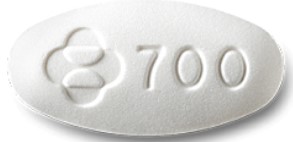 100 mgImage
Coformulations
Doravirine / Lamivudine / Tenofovir DF (Delstrigo)
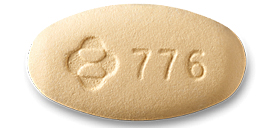 DOR 100 mg, 3TC 300 mg, TDF 300 mgImage
1 tablet daily Film-Coated Tablets
Clinical Use
Initial vs Subsequent Therapy
Adult and adolescent treatment guidelines of the U.S. Department of Health andHuman Services designate both doravirine/TDF/emtricitabine and doravirine + tenofovir alafenamide (TAF)/emtricitabine as "recommended initial regimens in certain clinical situations."
Doravirine has been studied in antiretroviral-naive adults in 2 Phase IIIrandomized double-blind studies. In the first of these, called DRIVE-FORWARD,769 patients (84% male) received either doravirine (100 mg once daily) ordarunavir (800 mg once daily) + ritonavir (100 mg once daily), each incombination with 2 NRTIs (either abacavir/lamivudine [13%)] or tenofovirDF/emtricitabine [87%], as selected by investigators). After 48 weeks oftreatment, by FDA snapshot analysis, HIV suppression to <50 copies/mL wasseen in 84% of doravirine recipients and 80% of darunavir recipients; thedifference was not statistically significant.(1) For patients whosebaseline HIV RNA was =100,000 copies/mL or whose CD4 count was <200cells/µL, rates of HIV RNA suppression to <50 copies/mL were lower butthey were not significantly different in the two treatment groups: (for the HIVRNA =100,000 group, viral suppression was seen in 81% of doravirinerecipients and 76% of darunavir recipients; for the CD4 <200 cells/µLgroup, viral suppression rates were 83% vs 72%). Mean CD4 cell count increasesin the two treatment groups were 193 cells/µL and 186 cells/µL,respectively. At 96 weeks, by FDA snapshot analysis, 73% of the doravirine groupand 66% of the darunavir group had HIV RNA <50 copies/mL.(3)
In the second Phase III study, called DRIVE-AHEAD, 728 patients were randomizedto one of two single-pill coformulations, either doravirine/tenofovirDF/lamivudine or efavirenz/tenofovir DF/emtricitabine. At 48 weeks, by FDAsnapshot approach, HIV RNA was <50 copies/mL in 84% of the doravirine groupand 81% of the efavirenz group; the difference was not statisticallysignificant. Mean CD4 count increases were 198 cells/µL in the doravirine group and188 cells/µL in the efavirenz group.(2)
Doravirine has not been studied in treatment-experienced patients with a historyof virologic failure.
Adverse Effects
Symptomatic side effects of doravirine include headache, nausea, diarrhea, andrash. In clinical studies to date, rash typically was not serious and usuallyresolved without discontinuation of doravirine.
Laboratory abnormalities include elevations in hepatic transaminases and totalbilirubin. Modest declines in total cholesterol, LDL cholesterol, andtriglycerides were seen in the Phase III studies.
It is important to assess patient motivation and discuss possible adverse effectsand strategies for their management before treatment with doravirine isinitiated.
Doravirine has not been studied in pregnant women.
Interactions with Other Drugs
Doravirine is metabolized by hepatic cytochrome P450 3A, and drugs that induce orinhibit the action of this isoenzyme may alter serum doravirine levels. In somecases, these interactions may be therapeutically significant. For example,inducers of cytochrome P450 3A such as rifampin and rifapentine, certainanticonvulsants (eg, carbamazepine and phenytoin), and St. John's wort maysubstantially decrease doravirine concentrations and should not be given topersons who take doravirine. Rifabutin may be given concurrently if thedoravirine dosage is increased (to 100 mg twice daily) to compensate for thedrug-drug interaction.(4) Cytochrome P450 3A inhibitors such asritonavir and ketoconazole may increase doravirine levels, but dosage adjustmentis not recommended.(4)
Adequate pharmacokinetic data and clinical correlates are not yet available formany potential interactions. Information on drug interactions should beconsulted, as dosage adjustments are frequently required and some combinationsare contraindicated.
For additional information, see "Database of Antiretroviral Drug Interactions."
Resistance
Resistance to doravirine is associated with the selection of 1 or more resistancemutations, but the resistance profile of doravirine has not been characterizedfully. In the Phase III clinical studies described above (see "Use in Initial and Subsequent Therapy"), anumber of reverse transcriptase mutations emerged in the setting of doravirinefailure. These include V106I, other V106 mutations (V106A/M/T), A98G, V108I,E138G/K, Y188L, H221Y, F227C/I/R, and Y318F. Phenotypic analysis showedhigh-level resistance to doravirine with various combinations of thesemutations. In these studies of initial therapy, emergent resistance todoravirine often was accompanied by resistance mutations that affect nucleosidereverse transcriptase inhibitors.
Implications of resistance to doravirine for treatment with other antiretrovirals
Phenotypic analyses from the Phase III studies of doravirine showed that emergentresistance to doravirine (see "Resistance," above, for specific mutations) generally caused cross-resistance to efavirenz andrilpivirine; etravirine remained active against viruses with certaincombinations of mutations.(5) To date, no clinical studies haveevaluated the effects of doravirine resistance on virologic outcomes ofsecond-line antiretroviral regimens.
Implications of resistance to other antiretrovirals for treatment with doravirine
Data on the effects of baseline resistance mutations on doravirine efficacy arelimited. Resistance mutations selected by other NNRTIs, including any of thesubstitutions listed above, would be expected to contribute to doravirineresistance. In vitro studies have suggested that doravirine has activity againstviruses with certain mutations selected by other NNRTIs, including the K103N andY181C mutations, but not on viruses with Y188L or some combinations that includeY106A or E138K.(4),(6) Clinical data will be needed to define the effect of resistance mutations on the activity of doravirine.
Resources and Links
References
- 1Molina JM, Squires K, Sax PE, et al. Doravirine versus ritonavir-boosted darunavir in antiretroviral-naive adults with HIV-1 (DRIVE-FORWARD): 48-week results of a randomised, double-blind, phase 3, non-inferiority trial. Lancet HIV. 2018 May;5(5):e211-e220.
- 2Squires KE, Molina JM, Sax PE, et al. Fixed-dose combination of doravirine/lamivudine/TDF is non-inferior to efavirenz/emtricitabine/TDF in treatment-naive adults with HIV-1 infection: week 48 results of the Phase 3 DRIVE-AHEAD study. In: Program and abstracts of the 9th IAS Conference on HIV Science; July 23-26, 2017; Paris. Abstract TUAB0104LB.
- 3Molina JM, Squires K, P. Sax, et al. Doravirine (DOR) versus ritonavir-boosted darunavir (DRV+r): 96-week results of the randomized, double-blind, phase 3 DRIVE-FORWARD noninferiority trial. In: Program and abstracts of the 22nd International AIDS Conference; July 23-27, 2018; Amsterdam. Abstract LBPEB017.
- 4Pifeltro prescribing information. Merck Sharpe & Dhome: South San Francisco, CA.
- 5Lai MT, Xu M, Ngo W, et al. Characterization of doravirine-selected resistance patterns from participants in treatment-naive Phase 3 clinical trials. In: Program and abstracts of the 22nd International AIDS Conference; July 23-27, 2018; Amsterdam. Abstract THPDB0101.
- 6Feng M, Sachs NA, Xu M, et al. Doravirine suppresses common nonnucleoside reverse transcriptase inhibitor-associated mutants at clinically relevant concentrations. Antimicrob Agents Chemother. 2016 Mar 25;60(4):2241-7.
-