
- Abbreviation: TPVAntiretroviral Subclass:Protease Inhibitors
Background
- U.S. Manufacturer:
Approval
Tipranavir received FDA approval in June 2005 for use in combination with ritonavir in adults with HIV infection. In 2008, it received approval for children age 2 years and older. It is intended to be used as part of combination therapy in patients who have HIV strains that are resistant to multiple other protease inhibitors and who have ongoing viral replication while taking antiretroviral therapy.
FDA approval was based on 2 Phase III studies in patients with extensive prior treatment with protease inhibitors, nucleoside analogues, and nonnucleoside reverse transcriptase inhibitors. All patients had HIV-1 with evidence of resistance to protease inhibitors. These open-label trials randomized patients to tipranavir (boosted by ritonavir) or to a comparator ritonavir-boosted protease inhibitor. The specific comparator (amprenavir, indinavir, lopinavir, or saquinavir) was selected for each patient with the assistance of resistance testing. Each patient also was given an optimized background regimen, which could include enfuvirtide. At 24 and 48 weeks, the tipranavir group had higher rates of virologic response (defined as ≥1 log10 decrease in HIV RNA) and viral suppression to <400 copies/mL and to <50 copies/mL than did the comparator group; these differences were statistically significant.(1),(2),(3)
Generic Approval
NA
Formulations and Dosing
Tipranavir is available in capsules and in oral solution. It is approved for twice-daily dosing and must be taken in combination with ritonavir to achieve effective plasma concentrations.
- Tipranavir should be taken with food.
- The concentration of tipranavir oral solution is 100 mg/mL. The solution should be stored at 77°F (25°C).
- Tipranavir interacts with other medications, including some antiretrovirals; dosage adjustments may be required and certain combinations are contraindicated. For more information about drug interactions, see "Combinations" below and refer to the Database of Antiretroviral Drug Interactions.
- No dosage adjustment is necessary in renal insufficiency.
- Please consult product labeling for detailed dosing information.
Adult Dosing
Dosage Formulation Notes Tipranavir 500 mg BID + ritonavir 200 mg BID Capsules Abbreviations: BID, twice daily.
Boosted
Pediatric Dosing
Age Dosage Formulation Weight 2-18 years Tipranavir 14 mg/kg BID + ritonavir 6 mg/kg BID (or tipranavir 375 mg/m2 BID + ritonavir 150 mg/m2 BID); not to exceed tipranavir 500 mg BID + ritonavir 200 mg BID Capsules Abbreviations: BID, twice daily.
Boosted
Formulations
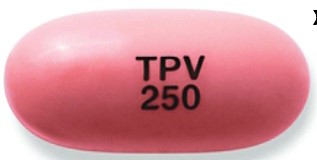 250-mg capsules 100-mg/mL oral solution
Image
Coformulations
Clinical Use
Initial vs Subsequent Therapy
Adult and adolescent treatment guidelines of the U.S. Department of Health and Human Services designate tipranavir as "not recommended" for initial treatment of HIV infection, because of inferior efficacy compared with recommended agents.
Currently, tipranavir (coadministered with ritonavir) is FDA approved only for use in subsequent therapy in patients with viral resistance to multiple protease inhibitors. Studies in initial therapy are under way.
In patients with advanced HIV disease, extensive prior exposure to at least 3 classes of antiretrovirals, and evidence of resistance to protease inhibitors, 2 Phase III studies (described above in "Approval") compared tipranavir/ritonavir with several other ritonavir-boosted protease inhibitors, each in combination with a background regimen. By intent-to-treat analysis, the combined tipranavir groups had higher rates of virologic response (34% vs 15%), viral suppression to <400 copies/mL (30% vs 14%), and viral suppression to <50 copies/mL (23% vs 10%) at 48 weeks.(3) These differences were statistically significant (p < .0001). The inclusion of enfuvirtide in the antiretroviral regimen significantly improved the rates of virologic response in the tipranavir groups (HIV RNA <400 copies/mL 43% vs 27% of tipranavir recipients treated with and without enfuvirtide, respectively; p < .0001). The tipranavir groups also had greater increases in CD4 cell counts than the comparator groups: 48 cells/µL vs 21 cells/µL (p < .0001).(3)
Factors Affecting Adherence
Symptomatic adverse effects of tipranavir include diarrhea, nausea, vomiting, and rash. Rash appears to be more common in women. In Phase III studies, liver toxicity, including life-threatening hepatic decompensation, was seen more frequently in the tipranavir groups than in the comparator groups, and was more common in patients with chronic hepatitis B or C.(3),(5),(6) Patients with moderate or severe hepatic insufficiency should not receive tipranavir. All patients receiving tipranavir should be monitored closely for hepatotoxicity. Tipranavir caused elevations in total cholesterol and triglycerides in a high proportion of study patients (in Phase III studies, 15% of tipranavir recipients developed cholesterol levels >300 mg/dL and 45% developed triglyceride levels >400 mg/dL).(3),(5),(6) Lipid parameters should be monitored regularly.
The combination of tipranavir + ritonavir has been associated with intracranial hemorrhage in a small number of patients. The relationship, if any, between tipranavir + ritonavir and these events is not yet known; pending further study, tipranavir should be used with caution in patients who are at risk of increased bleeding or who are on medications that may increase the risk of bleeding.(6)
Tipranavir contains a sulfonamide moiety and should be used cautiously in patients with sulfonamide allergy. It is important to assess patient motivation and discuss possible adverse effects and strategies for their management before treatment with tipranavir is initiated.
Tipranavir has not been studied in pregnancy.
Resistance
Resistance to tipranavir is associated with the selection of 1 or more of several resistance mutations.
Implications of tipranavir resistance for treatment with other antiretrovirals
In vitro studies of tipranavir + ritonavir show the emergence of a number of protease mutations. The resistance profile in human subjects has not been characterized fully. Results from studies of tipranavir in antiretroviral-naive patients (now under way) are needed to identify tipranavir resistance in initial therapy and to assess its implications for subsequent treatment. In patients with multiple preexisting mutations associated with resistance to protease inhibitors, emergent protease mutations included amino acid substitutions 10V/I/S, 13V, 33F/I/V, 82L/T, and 84V.(4),(5),(6)
Implications of resistance to other antiretrovirals for tipranavir treatmentResistance mutations selected by other protease inhibitors can contribute to tipranavir resistance. Mutations at protease codons 10, 13, 20, 33, 35, 36, 43, 46, 47, 54, 58, 69, 74, 82, 83, and 84 are associated with decreased virologic response to tipranavir. In addition, the total number of primary protease mutations is associated with diminished response to tipranavir.(3),(4),(5),(6)
Phenotypic analysis has demonstrated that virologic response to tipranavir/ritonavir is most likely if the baseline tipranavir fold change in IC50 value (compared with reference tipranavir susceptibility) is ≤ 3-fold.(3),(5)
Regimens containing tipranavir + ritonavir and enfuvirtide may be effective as subsequent regimens in individuals without prior enfuvirtide experience, and appear to be more effective than regimens containing tipranavir + ritonavir without enfuvirtide. Genotypic or phenotypic testing may be useful in predicting the likelihood of response to tipranavir following failure of regimens containing other antiretrovirals.
Resources and Links
References
- 1Hicks C, et al. RESIST-1: A Phase 3 Randomized, Controlled, Open-Label Multicenter Trial Comparing Tipranavir/Ritonavir (TPV/r) to an Optimized Comparator Protease Inhibitor/r (CPI/r) Regimen in Antiretroviral (ARV) Experienced Patients: 24-Week Data. In: Program and abstracts of the 44th Interscience Conference on Antimicrobial Agents and Chemotherapy; October 31-November 2, 2004; Washington. Abstract 1137a.
- 2Cahn P, et al. 24-week data from RESIST 2: phase 3 study of the efficacy and safety of either tipranavir/ritonavir (TPV/r) or an optimized ritonavir (RTV)-boosted standard-of-care (SOC) comparator PI (CPI) in a large randomized multicenter trial in treatment-experienced HIV+ patients. In: Program and abstracts of the Seventh International Congress on Drug Therapy in HIV Infection; November 14-17, 2004; Glasgow, UK. Abstract PL14.3.
- 4Boehringer Ingelheim Pharmaceuticals, Inc. Tipranavir Anti-Viral Drugs Advisory Committee (AVDAC) Briefing Document. April 19, 2005. Available at: www.fda.gov/ohrms/dockets/ac/05/briefing/2005-4139b1-02-boehringer.pdf.
- 5Tipranavir Review Team (HFD-530), Memorandum to FDA Antiviral Advisory Committee Members/Guests. April 22, 2005. Available at: www.fda.gov/ohrms/dockets/ac/05/briefing/2005-4139b1-01-fda.pdf
- 6Aptivus [package insert]. Boehringer Ingelheim GmbH, Germany; 2006. Available at: www.fda.gov/medwatch/safety/2006/Aptivus_PI.pdf
- 7Walmsley S, Leith J, Katlama C, et al. Pharmacokinetics and safety of tipranavir/ritonavir (TPV/r) alone and in combination with saquinavir (SQV), amprenavir (APV), or lopinavir (LPV): Interim analysis of BI1182.51. In: Program and abstracts of the XV International AIDS Conference; July 11-16, 2004; Bangkok, Thailand. Abstract WeOrB1236.
-