
- Abbreviation: AZT, ZDVAntiretroviral Subclass:Nucleoside reverse transcriptase inhibitors
Background
- U.S. Manufacturer:
Approval
Zidovudine was the first drug to be approved for treatment of HIV infection. FDA approval was granted in 1987 for advanced HIV disease in adults and in 1990 for pediatric use. Initial approval was based on evidence of a short-term survival advantage over placebo when zidovudine was given to patients with advanced HIV disease.(1) Although the survival benefit of therapy with zidovudine alone lasted only for several months, combination therapies including zidovudine were later found to delay the complications of HIV infection by many months or years. Approval was expanded in 1990 to include less-advanced stages of HIV disease. FDA approval of zidovudine for prevention of HIV transmission from mothers to infants was granted in 1994.
Generic Approval
A number of generic formulations have been approved by the FDA for use in the United States and other countries. Previously, these generic products had received "tentative approval" status for purchase and use as only part of the President's Emergency Plan for AIDS Relief (PEPFAR) in resource-limited countries.
Formulations and Dosing
Zidovudine is available in capsule, tablet, and syrup formulations, and in intravenous form. Zidovudine is also available in combination with lamivudine as a single tablet (Combivir), and in combination with lamivudine and abacavir as a single tablet (Trizivir). Generic versions of of the lamivudine/zidovudine have been granted "tentative approval" status by the FDA for purchase and use as part of PEPFAR. Combination tablets are also available in the United States, and various generic coformulations that include zidovudine are available in other countries.
- Zidovudine is not FDA approved for use in children <4 weeks of age. However, it has been studied in younger children; see Guidelines for the Use of Antiretroviral Agents in Pediatric HIV Infection.
- Use zidovudine syrup for children who are unable to swallow pills (if the intravenous formulation is needed; see Guidelines for the Use of Antiretroviral Agents in Pediatric HIV Infection for dosage information).
- Zidovudine dosage may be based on body surface area (BSA) instead of on body weight; the recommended dosage (syrup, capsules, or tablets) is 240 mg/m2 BID or 160 mg/m2 TID; maximum dosage 300 mg BID or 200 mg TID
- There are no food restrictions.
- Dosage adjustment is recommended in renal insufficiency.
- There are no data on dosage adjustment in hepatic impairment.
- Please consult product labeling for detailed dosing information zidovudine tablets, capsules, or syrup or zidovudine intravenous.
Adult Dosing
Dosage Formulation Notes 300 mg BID Capsules 200 mg TID Capsules Key to abbreviations: BID = twice daily; TID = 3 times daily
Pediatric Dosing
Age Dosage Formulation Weight Neonatal See Guidelines for the Use of Antiretroviral Agents in Pediatric HIV Infection Capsules 4 weeks to <18 years BID or 8 mg/kg TID (total daily dosage: 24 mg/kg/day) Capsules 12 mg/kg 4 weeks to <18 years 9 mg/kb BID or 6 mg/kg TID (total daily dosage: 18 mg/kg/day) Capsules ≥9 kg to <30 kg 4 weeks to <18 years Adult dosage Capsules ≥30 kg Key to abbreviations: BID = twice daily; TID = 3 times daily
Formulations
 300 mgImage
 100 mgImage
 10 mg/mLImage
Coformulations
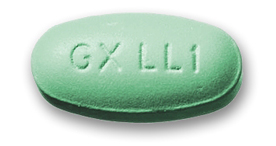
Abacavir / Lamivudine / Zidovudine (Trizivir)
Clinical Use
Initial vs Subsequent Therapy
Adult and adolescent treatment guidelines of the U.S. Department of Health and Human Services (HHS) state that zidovudine + lamivudine is "not recommended" for initial treatment of HIV infection, because of greater risk of toxicity than recommended nucleoside medications. The HHS treatment guidelines for pregnant women consider zidovudine + lamivudine to be an "alternative" dual-nucleoside option for combination therapy to prevent perinatal HIV transmission.
A direct comparison of zidovudine with stavudine, each in combination with lamivudine and the protease inhibitor indinavir as initial therapy,(2) found no difference in the two regimens in maintaining viral load suppression at 48 weeks. Although serious adverse events were not significantly different between treatment arms, there was increased nausea and vomiting in the zidovudine-containing arm, and increased diarrhea and rash in the stavudine-containing arm.
A comparison of zidovudine with abacavir, each in combination with lamivudine and efavirenz as initial therapy, showed equivalent rates of virologic suppression at 48 weeks, and greater increases in CD4 cell count in the abacavir group.(3) A 48-week comparison of zidovudine + lamivudine with tenofovir + emtricitabine, each in combination with efavirenz in previously untreated patients, found lower rates of virologic suppression in the zidovudine + lamivudine group (HIV RNA <50 copies/mL in 70% vs 80%; p = .02), and higher rates of treatment-limiting adverse effects (such as anemia).(4)
Although many antiretroviral combinations containing zidovudine have been found to be effective at suppressing HIV viral load and increasing CD4 cell counts, 3-drug combinations that include a protease inhibitor or nonnucleoside reverse transcriptase inhibitor generally have been found to have a more sustained effect than nucleoside-only combinations.
Adverse Effects
Symptomatic side effects of zidovudine include loss of appetite, nausea, vomiting, malaise, headache, weakness, and dizziness. These symptoms frequently resolve within the first few weeks of treatment, but can persist and may lead to early treatment discontinuation.
Nucleoside analogues, including zidovudine, may be associated with mitochondrial toxicity leading to potentially serious long-term side effects such as lactic acidosis and disorders of body fat composition.(5)
Potential laboratory abnormalities include anemia and neutropenia, which may be severe. Concurrent administration of other myelosuppressive drugs increases the risk of bone marrow toxicity. Patients should be closely monitored for these effects.
It is important to assess patient motivation and discuss possible side effects and strategies for their management before treatment with zidovudine is initiated.
Interactions with Other Drugs
Zidovudine and stavudine should not be used in combination because they compete with each other for activation by intracellular phosphorylation, resulting in diminished antiviral activity.(6) Similarly, ribavirin and doxorubicin are antagonistic to zidovudine and should not be coadministered.
Resistance
Resistance to zidovudine is associated with the selection of 1 or more of several resistance mutations, in particular at reverse transcriptase codons 41, 67, 70, 210, 215, and 219.
Implications of zidovudine resistance for treatment with other antiretrovirals
Resistance to zidovudine appears to emerge over time in a stepwise manner, with successive mutations increasing the degree of viral resistance. Resistance generally proceeds along one of two mutation pathways. Depending on the specific mutations and the number of mutations, resistance to zidovudine is associated with some degree of resistance to other nucleoside analogues. The presence of resistance to lamivudine and emtricitabine (ie, the M184V mutation) may partially or fully reverse the effects of zidovudine resistance mutations.(7)
Implications of resistance to other antiretrovirals for treatment with zidovudine
Depending on the number of mutations and the specific mutations, resistance to other nucleoside analogues may result in resistance to zidovudine.
- Treatment with stavudine may select mutations associated with zidovudine resistance.
- Individual mutations associated with resistance to other nucleoside analogues are not usually found to confer resistance to zidovudine. However, the coexistence of more than 2 nucleoside resistance mutations often confers resistance to zidovudine.
- The codon 184 mutation, associated with resistance to lamivudine and emtricitabine, does not confer resistance to zidovudine and, in fact, may increase susceptibility to zidovudine. When present with thymidine-associated mutations, it may partially restore sensitivity to zidovudine.
- The K65R mutation, which may be selected by several nucleoside analogues, is associated with increased susceptibility to zidovudine.
Special Uses
In a retrospective analysis, zidovudine was found to be effective in reducing the risk of HIV infection following occupational exposure.(8) For this reason, zidovudine is recommended by USPHS guidelines as an option for inclusion in postexposure prophylaxis regimens, if exposure to zidovudine-susceptible HIV is likely.
Zidovudine regimens including antenatal, peripartum, and neonatal treatment have shown a dramatic reduction in mother-to-child transmission of HIV in previously untreated mothers.(9) Currently, the USPHS recommends the combination of zidovudine plus lamivudine as the preferred nubleoside analogue backbone in an effective antenatal regimen. It also recommends peripartum (in women with HIV RNA >400 copies/mL) and neonatal administration of zidovudine.
Resources and Links
References