
- Abbreviation: LPV/rAntiretroviral Subclass:Protease Inhibitors
Background
- U.S. Manufacturer:
Approval
The coformulation of lopinavir + ritonavir (lopinavir/ritonavir) received FDA approval in 2000 for treatment of HIV in adults and children age 6 months or older. In 2008, it received approval for use in infants. Approval was based on a study (1) showing comparable rates of viral suppression at 24 weeks of initial treatment in individuals receiving lopinavir/ritonavir + stavudine + lamivudine compared with those receiving nelfinavir + stavudine + lamivudine. Subsequent follow-up of a noncontrolled study showed that viral load suppression with this lopinavir/ritonavir combination persists through 4 years.(2) A tablet formulation of lopinavir/ritonavir received FDA approval in November 2005.
Formulations and Dosing
Lopinavir/ritonavir is available in tablet and oral liquid formulations. Two tablet formulations are available: 200 mg lopinavir + 50 mg ritonavir and 100 mg lopinavir + 25 mg ritonavir (the latter is for pediatric dosing). The liquid formulation contains 80 mg lopinavir + 20 mg ritonavir per mL. The liquid formulation is 42% ethanol by volume.
Lopinavir/ritonavir is approved for twice-daily dosing; it also is approved for once-daily dosing in adults whose virus does not have significant resistance to lopinavir. For treatment-experienced patients with ≥3 lopinavir-associated mutations, and for pregnant women, only the twice-daily option is recommended.
Adult Dosing
Dosage Formulation Notes 800/200 mg QD Tablet 400/100 mg BID Tablet QD dosing is recommended only for nonpregnant adults with <3 lopinavir-associated resistance mutations (resistance mutations (L10F/I/R/V, K20M/N/R, L24I, L33F, M36I, I47V, G48V, I54L/T/V, V82A/C/F/S/T, and I84V). Lopinavir/ritonavir should not be administered once-daily in regimens that include efavirenz, nevirapine, amprenavir, fosamprenavir, or nelfinavir.
Pediatric Dosing
Age Dosage Formulation Weight 6 months to 18 years 400/100 mg BID Tablets >35 kg 6 months to 18 years 200/50 mg BID Tablets 15 kg to 25 kg 6 months to 18 years Tablets 7 kg to 15 kg 6 months to 18 years 300/75 mg BID Tablets >25 to 35 kg 14 days to 6 months Oral Solution 6 months to 18 years 1.25 mL BID Oral Solution 7 kg to 10 kg 6 months to 18 years 1.75 mL BID Oral Solution >10 kg to <15 kg 6 months to 18 years 2.25 mL BID Oral Solution 15 kg to 20 kg 6 months to 18 years 2.75 mL BID Oral Solution >20 to 25 kg 6 months to 18 years 3.5 mL BID Oral Solution >25 to 30 kg 6 months to 18 years 4 mL BID Oral Solution >30 to 35 kg 6 months to 18 years 4.75 mL BID Oral Solution >35 to 40 kg 6 months to 18 years 5 mL BID Oral Solution >40 kg Adult dosing. Available in 200/50 tabs or 100/25 tabs
Available in 200/50 tabs or 100/25 tabs
not recommended, use oral solution
Formulations
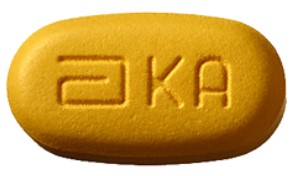 200 mg lopinavir and 50 mg ritonavir
Image
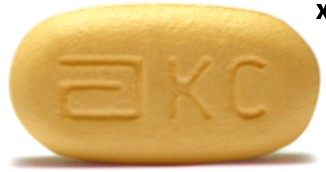 100 mg lopinavir and 25 mg ritonavirImage
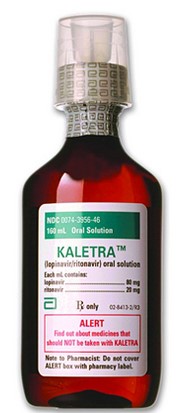 80 ml/ 20 mlImage
Coformulations
Clinical Use
Initial vs Subsequent Therapy
Adult and adolescent treatment guidelines of the U.S. Department of Health and Human Services state that lopinavir/ritonavir given twice daily in combination with 2 nucleoside analogues is "not recommended" for initial antiretroviral therapy. However, the guidelines list the combination of lopinavir/ritonavir (given twice daily) + lamivudine as an initial "regimen to consider" when abacavir, tenofovir alafenamide, and tenofovir disoproxil fumarate cannot be used.
Regimens containing lopinavir/ritonavir have been shown to achieve effective viral suppression in initial and subsequent therapy.
Lopinavir/ritonavir, used with stavudine and lamivudine as initial treatment, was significantly more effective in achieving virologic suppression than the combination of nelfinavir + stavudine + lamivudine (HIV RNA <50 copies/mL in 67% vs 52% at 48 weeks; p < .001).(1)
In a study comparing lopinavir/ritonavir with ritonavir-boosted fosamprenavir, the 2 boosted protease inhibitors, given in combination with abacavir + lamivudine, provided comparable rates of virologic suppression and similar increases in CD4 cell counts. At 48 weeks, by intent-to-treat analysis, the proportion of subjects with HIV RNA <50 copies/mL was 65% in the lopinavir/ritonavir group and 66% in the fosamprenavir + ritonavir group. CD4 count increases were 191 cells/µL and 176 cells/µL, respectively.(3)
In a randomized comparison between lopinavir/ritonavir and efavirenz, each given with 2 nucleoside analogues, lopinavir/ritonavir recipients had lower rates of virologic suppression to <50 copies/mL at 48 weeks (77% for lopinavir/ritonavir and 89% for efavirenz recipients; p = .003), though greater increases in CD4 cell counts (285 and 241 cells/µL, respectively; p = .01). A third treatment group was given efavirenz + lopinavir/ritonavir, without nucleoside analogues; 83% of subjects in this group had virologic suppression to <50 copies/mL.(4)
Following failure of initial treatment with 2 nucleoside analogues and a protease inhibitor other than lopinavir/ritonavir, a majority of patients with no prior NNRTI use experienced suppression of viral load for 48 weeks after switching to a regimen containing lopinavir/ritonavir, nevirapine, and 1 new nucleoside analogue.(5)
In a study of individuals with extensive nucleoside analogue and protease inhibitor experience (but no prior NNRTI experience) and virologic recurrence on treatment, changing to a regimen including lopinavir/ritonavir and efavirenz resulted in viral load suppression at week 24 in the majority of participants.(6)Adverse Effects
The most common symptomatic side effects of lopinavir/ritonavir are diarrhea and nausea. Common laboratory abnormalities include elevated cholesterol and triglyceride levels; liver toxicity and hyperglycemia are also observed. As with other protease inhibitors, lopinavir/ritonavir may contribute to abnormalities of body fat distribution. It is important to assess patient motivation and discuss possible side effects and strategies for their management before treatment with lopinavir/ritonavir is initiated.
Interactions with Other Drugs
The ritonavir component of lopinavir/ritonavir is a potent inhibitor of cytochrome P450 3A (CYP3A) and CYP2D6, as well as an inducer of other hepatic enzyme systems. Coadministration with lopinavir/ritonavir therefore causes clinically significant alterations in serum levels of several other antiretrovirals, and of a variety of drugs including certain cholesterol-lowering agents, rifabutin, antiarrhythmics, sedative-hypnotics, erectile dysfunction agents, oral contraceptives, methadone, recreational substances, and others.
Drugs that affect metabolism by CYP3A can affect lopinavir levels. For example, some antiretrovirals, including efavirenz, nevirapine, and fosamprenavir, as well as other medications such as rifampin decrease lopinavir levels significantly.
Information on drug interactions should be consulted, as dosage adjustments are frequently required, and some combinations are clearly contraindicated.
Resistance
Resistance to lopinavir is associated with the selection of several resistance mutations.
Implications of lopinavir resistance for treatment with other antiretroviralsResistance to lopinavir is seldom identified in the setting of viral rebound on lopinavir-containing initial regimens. In patients with preexisting mutations associated with protease inhibitors, new resistance mutations may emerge, and these likely would decrease the efficacy of other protease inhibitors. Genotypic or phenotypic analysis may be useful in predicting the response to protease inhibitors following failure of regimens containing lopinavir/ritonavir.
Implications of resistance to other antiretrovirals for lopinavir treatmentWhile no single mutation appears to confer high-level resistance to lopinavir, resistance mutations selected by other protease inhibitors, in particular L10F/I/R/V, K20M/N/R, L24I, L33F, M36I, I47V, G48V, I54L/T/V, V82A/C/F/S/T, and I84V, can contribute to resistance. The probability of lopinavir/ritonavir treatment failure increases with each additional mutation.(7)
Genotypic or phenotypic testing may be useful in predicting the likelihood of response to lopinavir/ritonavir following failure of regimens containing other antiretrovirals.
Resources and Links
References
- 4Riddler SA, Haubrich R, DiRienzo G, et al. A prospective, randomized, phase III trial of NRTI-, PI-, and NNRTI-sparing regimens for initial treatment of HIV-1 infection: ACTG 5142. In: Program and abstracts of the XVI International AIDS Conference; August 13-18, 2006; Toronto. Abstract THLB0204.
- 6Becker S, Brun S, Bertz R, et al. ABT-378/ritonavir (ABT-378/r) and Efavirenz: 24 Week Safety/Efficacy Evaluation in Multiple PI Experienced Patients. In: Program and abstracts of the 40th Interscience Conference on Antimicrobial Agents and Chemotherapy; September 17-20, 2000; Toronto. Abstract 697.
- 7King MS, Rode R, Cohen-Codar I, et al. Predictive genotypic algorithm for virologic response to lopinavir-ritonavir in protease inhibitor-experienced patients. Antimicrob Agents Chemother. 2007 Sep;51(9):3067-74.