
- Abbreviation: T-20Antiretroviral Subclass:Entry, fusion, and attachment inhibitors
Background
- U.S. Manufacturer:
Approval
Enfuvirtide was approved by the FDA in March 2003 for use in adults, and in children ages 6 and older, with advanced HIV infection. The first agent to be approved in the class of fusion inhibitors, enfuvirtide functions by binding a region of the HIV envelope glycoprotein gp41 and preventing viral fusion with the target cell membrane.
FDA approval was based on 2 randomized, open-label Phase III studies (TORO 1 and TORO 2) of enfuvirtide used in patients with viral loads >5,000 copies/mL and prior experience with (or documented resistance to) each of the NRTI, NNRTI, and PI drug classes.(1),(2),(3) In these highly pretreated patients, the combination of enfuvirtide with individualized background regimens of antiviral agents, compared with individualized background regimens alone, resulted in significantly greater decreases in viral load at 24 and 48 weeks and better rates of viral suppression (HIV RNA <400 copies/mL in 30% vs 12% at 48 weeks; p < .0001). Significantly greater CD4 cell increases were seen in the enfuvirtide groups than in the control groups (a difference of 46 cells/µL at 48 weeks in pooled analyses; p < .0001).(3)
Formulations and Dosing
Enfuvirtide is administered by subcutaneous injection. It is available in powder form and must be reconstituted with sterile water. Single-dose vials contain 108 mg of enfuvirtide for the delivery of approximately 90 mg/mL when reconstituted. Standard dosing is twice daily.
- There are no food restrictions
- No dosage adjustment is necessary in renal insufficiency
- Please consult product labeling for detailed dosing information
Adult Dosing
Dosage Formulation Notes 90 mg SQ BID Subcutaneous Injection Pediatric Dosing
Age Dosage Formulation Weight <6 years 6 to 16 years 2 mg/kg SQ BID; maximum dose 90 mg SQ BID >16 years 90 mg SQ BID (Adult dose) not FDA approved
Formulations
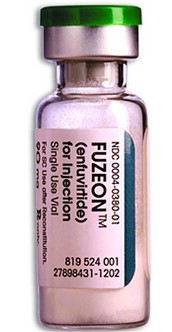 90mg/mL (reconstituted)
Image
Coformulations
Clinical Use
Initial vs Subsequent Therapy
Treatment guidelines of the U.S. Department of Health and Human Services designate enfuvirtide as "not recommended" in initial therapy.
There are no data on the use of enfuvirtide in initial therapy. The FDA has approved enfuvirtide only for use in advanced HIV disease. Given the complexity of its administration, as well as its cost, enfuvirtide is likely to be reserved for salvage therapy.
Enfuvirtide has been shown to be effective in treatment-experienced patients with detectable HIV RNA, indicating an important role in subsequent therapy. In randomized controlled studies of protease inhibitors in subjects harboring resistance to the NRTI, NNRTI, and PI classes, subjects who received enfuvirtide had better virologic responses than those who did not.(3),(5),(6) In studies of darunavir and of tipranavir, subjects who received either of these PIs in combination with enfuvirtide had better virologic outcomes than those who received the comparator PIs plus enfuvirtide. In darunavir recipients, the inclusion of enfuvirtide in the antiretroviral regimen of those without previous enfuvirtide exposure significantly improved the rates of virologic response (HIV RNA <50 copies/mL in 58% vs 44% of patients treated with and without enfuvirtide, respectively).(5) In tipranavir recipients, similarly, the use of enfuvirtide significantly improved the likelihood of virologic suppression (HIV RNA <400 copies/mL at 48 weeks in 43% vs 27% and <50 copies/mL in 28% vs 21%) of tipranavir recipients treated with and without enfuvirtide, respectively).(6) In these salvage therapy settings, the efficacy of an enfuvirtide-containing regimen appears to depend most notably on the susceptibility of the virus to the other antiretroviral agents used concomitantly, indicating the importance of including at least 2 agents with potent activity in the antiretroviral regimen.(3),(5),(6)
Factors Affecting Adherence
The most common adverse effects of enfuvirtide are injection site reactions. These painful, erythematous nodules occurred in up to 98% of prelicensing study subjects, but typically were mild to moderate in severity and rarely led to discontinuation of the drug.(8) Other symptomatic side effects may include insomnia, headache, dizziness, and nausea. Several cases of hypersensitivity have been described. In Phase III studies, bacterial pneumonia was seen at a higher rate in patients who received enfuvirtide than in those who did not receive enfuvirtide.(8) Eosinophilia is the primary laboratory abnormality seen with enfuvirtide administration.
Enfuvirtide is administered by subcutaneous injection; proper administration requires careful instruction and support. It is important to assess patient motivation and likelihood of adherence, and to discuss possible side effects and strategies for their management, before initiating treatment with enfuvirtide.
Resistance
Resistance to enfuvirtide may result from one or more of several mutations in gp41.(9) The incidence and significance of specific enfuvirtide mutations is being studied in ongoing trials.
Implications of enfuvirtide resistance for treatment with other antiretrovirals
Enfuvirtide is currently the only agent in the class of fusion inhibitor, and it has unique resistance mutations. Enfuvirtide-associated mutations do not affect sensitivity to other antiretrovirals (those in the NRTI, NNRTI, PI, coreceptor antagonist, or integrase inhibitor classes).
Implications of resistance to other antiretrovirals for treatment with enfuvirtide
Resistance to other currently available antiretroviral agents is not associated with resistance to enfuvirtide.
Resources and Links
References
- 5Lazzarin A, Queiroz-Telles F, Frank I, et al. TMC114 provides durable viral load suppression in treatment-experienced patients: POWER 1 and 2 combined week 48 analysis. 16th International AIDS Conference. August 13-18, 2006. Toronto, Canada. Abstract TUAB0104.
- 7Boyd M, Ruxrungtham K, Zhang X, Bellibas E, Buss NE, Patel IH. Enfuvirtide: Investigations on the drug interaction potential in HIV-infected patients. 10th Conference on Retroviruses and Opportunistic Infections. February 10-14, 2003, Boston. Abstract 541.
- 9Greenberg ML, Melby T, Sista P, DeMasi R, Cammack N, Salgo M, Whitcomb J, Petropoulos C, Matthews TJ. Baseline and on-treatment susceptibility to Enfuvirtide seen in TORO 1 and TORO 2 to 24 weeks. 10th Conference on Retroviruses and Opportunistic Infections. February 10-14, 2003, Boston. Abstract 141.