
- Abbreviation: EVGAntiretroviral Subclass:Integrase inhibitors
Background
- U.S. Manufacturer:
Approval
Elvitegravir was granted approval by the U.S. Food and Drug Administration (FDA) in August 2012 as part of a coformulation that also includes the pharmacokinetic enhancer cobicistat and the two nucleoside/nucleotide analogues (NRTIs) tenofovir and emtricitabine. In September 2014, it was approved for use with a protease inhibitor coadministered with ritonavir plus other antiretrovirals. Elvitegravir requires pharmacokinetic enhancement with either cobicistat or ritonavir. In fixed-dose coformulations with cobicistat, it is intended for use in initial therapy of adults with HIV-1 infection. When used with a ritonavir-boosted protease inhibitor, it is intended for use in treatment-experienced adults. Elvitegravir is not currently approved for use in other combinations.
Initial approval was based primarily on 48-week results of 2 Phase 3 studies showing that previously untreated individuals who received elvitegravir/cobicistat/emtricitabine/tenofovir disoproxyl fumarate (TDF) had rates of viral suppression and CD4 T-cell increases that were similar to those of individuals who received either efavirenz + 2 NRTIs or atazanavir + ritonavir + 2 NRTIs.(1),(2)
Formulations and Dosing
Elvitegravir is available in a fixed-dose combination tablet formulation with cobicistat, emtricitabine, and tenofovir alafenamide (TAF) (Genvoya) and a fixed-dose combination tablet formulation with cobicistat, emtricitabine, and TDF (Stribild). It is no longer available as an independent medication.
Abbreviations: BID = twice daily; QD = once daily
- Elvitegravir should be taken with food.
- Elvitegravir has recognized interactions with several antiretroviral medications and the combination of elvitegravir + cobicistat or ritonavir interacts with a number of antiretrovirals; see product labeling for further information.
- Elvitegravir does not require dosage adjustment in patients with kidney disease, but the fixed-dose combination elvitegravir/cobicistat/emtricitabine/TDF should not be used in patients with CrCl <70 mL/min and should be discontinued in those with CrCl <50 mL/min; the fixed-dose combination elvitegravir/cobicistat/emtricitabine/TAF should not be used in patients with CrCl <30 mL/min, unless they have end-stage renal disease and are receiving chronic hemodialysis.
- Dosage adjustment for mild or moderate hepatic impairment is not required. No data are available to guide use in persons with severe liver disease.
- Elvitegravir is not recommended for use during pregnancy.
- Consult product labeling for detailed dosing information.
Adult Dosing
Dosage Formulation Notes 1 tablet Stribild daily (EVG 150 mg, COBI 150 mg, FTC 200 mg, TDF 300 mg)
Film-Coated Tablets 1 tablet Genvoya daily (EVG 150 mg, COBI 150 mg, FTC 200 mg, TAF 10 mg) Film-Coated Tablets coformulated only
Pediatric Dosing
Age Dosage Formulation Weight ≥12 years 1 tablet Stribild daily (EVG 150 mg, COBI 150 mg, FTC 200 mg, TDF 300 mg) Film-Coated Tablets ≥35 kg ≥12 years 1 tablet Genvoya daily (EVG 150 mg, COBI 150 mg, FTC 200 mg, TAF 10 mg) Film-Coated Tablets ≥35 kg Not FDA approved in patients <12 years of age or weighing less than <35 kg.
Coformulated only.
Coformulations
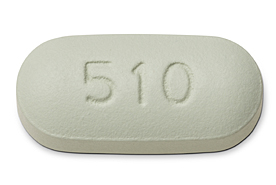 EVG 150 mg, COBI 150 mg, FTC 200 mg, TAF 10 mgImage
1 tablet daily Tablet 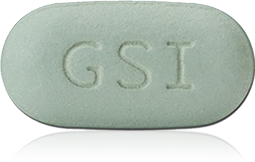 EVG 150 mg, COBI 150 mg, FTC 200 mg, TDF 300 mgImage
1 tablet daily Film-Coated Tablets
Clinical Use
Initial vs Subsequent Therapy
Adult and adolescent treatment guidelines of the U.S. Department of Health and Human Services designate the coformulation elvitegravir/cobicistat/emtricitabine/TAF and elvitegravir/cobicistat/emtricitabine/TDF as "recommended initial regimens in certain clinical situations."
Elvitegravir has been studied primarily in initial therapy in adults.
In a randomized, placebo-controlled Phase 3 study in antiretroviral-naive adults, the fixed-dose coformulation of elvitegravir/cobicistat/emtricitabine/TDF was compared with efavirenz/tenofovir/emtricitabine.(1) By intention-to-treat snapshot analysis, 88% of elvitegravir + cobicistat recipients and 84% of efavirenz recipients had HIV RNA levels of <50 copies/mL at 48 weeks; the difference was not statistically significant. Responses in the two groups also were similar in patients with pretreatment HIV RNA levels of >100,000 copies/mL. The mean increase in CD4 count was 239 cells/µL in the elvitegravir group and 206 cells/µL in the efavirenz group.
In a parallel Phase 3 study in antiretroviral-naive adults, the fixed-dose coformulation of elvitegravir/cobicistat/emtricitabine/TDF was compared with atazanavir + TDF + tenofovir/emtricitabine.(2) By intention-to-treat snapshot analysis, 89.5% of elvitegravir + cobicistat recipients and 87% of atazanavir + ritonavir recipients had HIV RNA suppression to <50 copies/mL; the difference was not statistically significant. In persons with baseline HIV RNA >100,000 copies/mL, rates of virologic suppression were very similar in the two treatment groups. Mean CD4 increases were approximately 210 cells/µL in each group.
Two Phase 3 studies compared the coformulations of elvitegravir/cobicistat/emtricitabine/TDF and elvitegravir/cobicistat/emtricitabine/TAF in initial treatment.(3) In combined analysis of the two studies, by FDA snapshot analysis, 90% and 92%% of study subjects, respectively, had HIV RNA levels of <50 copies/mL at 48 weeks; the difference was not statistically significant. The two ARV regimens yielded similar rates of HIV suppression in patients with pretreatment HIV RNA levels of >100,000 copies/mL and those with ≤100,000 copies/mL. Mean CD4 cell increases were nearly the same.
A smaller Phase 2 trial of initial therapy also found similar efficacy between elvitegravir/cobicistat/emtricitabine/TDF and efavirenz/TDF/emtricitabine at 48 weeks: 90% and 83%, respectively, had HIV RNA levels of <50 copies/mL. The median CD4 increases were 138 cells/µL and 170 cells/µL, respectively.(4)
Two parallel studies randomized patients with suppressed HIV RNA on regimens containing either a protease inhibitor (PI) or a nonnucleoside reverse transcriptase inhibitor (NNRTI) to switch to elvitegravir/cobicistat/emtricitabine/TDF or to continue their stable regimen. Patients were on their 1st or 2nd treatment regimen and could not have resistance to either tenofovir or emtricitabine. At 48 weeks, by snapshot analysis, HIV RNA remained <50 copies/mL in higher percentages of elvitegravir/cobicistat/emtricitabine/TDF recipients (94% vs 87% of PI recipients [95% CI: 0.4-13.7]; 93% vs 88% of NNRTI recipients [95% CI: -0.5-12]).(5),(6)
In treatment-experienced patients with resistance to at least 2 ARV classes, a Phase 3 randomized study compared elvitegravir with raltegravir, each given in combination with a ritonavir-boosted PI and at least 1 other active ARV. After 48 weeks of treatment, by modified intention-to-treat analysis, rates of HIV control were comparable in the two groups (<50 copies/mL in 59% and 58%, respectively), as were CD4 cell increases.(7)
Adverse Effects
Symptomatic side effects of elvitegravir appear to be few but may include diarrhea and rash. Laboratory abnormalities include elevations in hepatic transaminases. Adverse effects owing to coadministred cobicistat or ritonavir are expected (see specific ARV profiles).
It is important to assess patient motivation and discuss possible adverse effects and strategies for their management before treatment with elvitegravir is initiated.
Elvitegravir has not been studied in pregnant women.
Interactions with Other Drugs
Elvitegravir is primarily metabolized by cytochrome P450 3A (CYP3A) enzymes, so drugs that induce or inhibit the action of CYP3A may affect serum levels of elvitegravir. In some cases, these interactions may be therapeutically significant. For example, the nonnucleoside reverse transcriptase inhibitors efavirenz and nevirapine are expected to lower serum elvitegravir levels and should not be used with elvitegravir. Rifamycins (eg, rifampin and rifabutin), some anticonvulsants (eg, carbamazepine and phenytoin), and St. John's wort may decrease elvitegravir concentrations whereas azole antifungal drugs appear to increase them; concurrent treatment with elvitegravir is contraindicated.(8,9) Elvitegravir also induces CYP 2D9 and may lower concentrations of substrates of this enzyme.
Cobicistat and ritonavir strongly inhibit CYP3A, thus increasing plasma concentrations of elvitegravir; elvitegravir must be coadministered with one of these two drugs in order to achieve serum levels adequate to suppress HIV replication. The coadministered cobicistat or ritonavir, however, will have extensive interactions with other medications including other antiretroviral medications.(9) (See the Database of Antiretroviral Drug Interactions.)
Divalent cations (eg, magnesium- or aluminum-containing antacids) may bind elvitegravir and interfere with its activity against integrase. A pharmacokinetic study showed that administration of antacids containing divalent cations at the same time as elvitegravir lowered serum elvitegravir concentration by more than 40%. The effect was minimal if antacids were taken 4 hours apart from the integrase inhibitor.(9) Antacid medications and other agents with divalent cations should be used cautiously with (and taken separately from) elvitegravir. Proton pump inhibitors and H2 receptor antagonists do not affect elvitegravir concentrations.
Adequate pharmacokinetic data and clinical correlates are not yet available for many potential interactions. Information on drug interactions should be consulted, as dosage adjustments may be required and some combinations are contraindicated. Pending further study, coadministration of the elvitegravir/cobicistat/tenofovir/emtricitabine coformulation with other antiretrovirals is not recommended.
For additional information, see the Database of Antiretroviral Drug Interactions.
Resistance
Resistance to elvitegravir is associated with the selection of 1 or more resistance mutations, but the elvitegravir resistance profile has not been characterized fully. In vitro and in vivo studies show the emergence of a number of integrase mutations, including T66I, E92Q, Q148R, and N155H. Phenotypic analysis shows reduced susceptibility to elvitegravir if any of these mutations is present.
In the studies of initial therapy, emergent resistance to elvitegravir also usually involved development of the reverse transcriptase mutations M184I or M184V, which confer resistance to lamivudine and emtricitabine, with or without other mutations.
Implications of resistance to elvitegravir for treatment with other antiretrovirals
Among patients with resistance to elvitegravir, cross-resistance to raltegravir appears to occur in the majority of cases. The type and number of mutations appear to correlate with the degree of cross-resistance to raltegravir.(1),(2),(7),(8) Resistance mutations selected by elvitegravir may contribute to dolutegravir resistance, particularly if the Q148H/R mutation plus 2 or more other integrase inhibitor mutations is present.(10),(11)
Implications of resistance to other antiretrovirals for treatment with elvitegravir
Data on the effects of baseline integrase resistance mutations on elvitegravir efficacy are limited. In studies conducted to date, resistance to raltegravir was associated with phenotypic resistance to elvitegravir in nearly all cases.(7),(8),(12) In in vitro studies, the raltegravir-associated resistance mutations Y143R, Q148H/K/R, and N155H were associated with high levels of resistance to elvitegravir.
Resources and Links
References
- 8Stribild [prescribing information]. Gilead Sciences: Foster City, CA.