
- Abbreviation: DTGAntiretroviral Subclass:Integrase inhibitors
Background
- U.S. Manufacturer:
Approval
Dolutegravir was approved by the U.S. Food and Drug Administration (FDA) in August 2013 for use in initial and subsequent therapy in HIV-infected adults and children >12 years of age (and weight =40 kg).
It is intended for use as part of combination therapy.
Approval was based on 48-week results of 4 Phase III studies, 2 in first-line treatment and 2 in subsequent treatment. The Phase III studies of initial treatment demonstrated that individuals who received dolutegravir in combination with 2 NRTIs had rates of viral suppression and CD4 T-cell increases that were similar to those of individuals who received either raltegravir + 2 NRTIs or efavirenz + tenofovir/emtricitabine.(1),(2)
Generic Approval
NA
Formulations and Dosing
Dolutegravir is available in a film-coated tablet formulation. It also is available in single-tablet combinations with abacavir and lamivudine (Triumeq), with lamivudine (Dovato), and with rilpivirine (Juluca).
Dolutegravir is approved for once-daily and twice-daily dosing; frequency of dosing depends on the presence or absence of integrase inhibitor-associated resistance mutations and the concurrent use of certain other medications.
- There are no food restrictions.
- Dolutegravir interacts with other medications, including some antiretrovirals; dosage adjustments may be required and certain combinations are contraindicated. For more information about drug interactions, see "Interactions with Other Drugs" below and refer to the Database of Antiretroviral Drug Interactions.
- No dosage adjustment is necessary for patients with mild to moderate renal insufficiency. Serum concentrations are reduced in patients with severe renal impairment. Use with caution in patients with severe renal impairment who have integrase inhibitor resistance, as serum concentrations of dolutegravir may be subtherapeutic.
- No dosage adjustment is necessary for patients with mild to moderate hepatic impairment (Child-Pugh A or B); use in patients with severe hepatic impairment has not been studied and is not recommended.
- Dolutegravir is not recommended for women who may become pregnant while using it, or during the first 12 weeks of pregnancy; see Potential Adverse Effects.
- Consult product labeling for detailed dosing information.
Adult Dosing
Dosage Formulation Notes 50 mg QD (Treatment naive or with no mutations associated with resistance to dolutegravir*) Film-Coated Tablets 50 mg BID (Treatment experienced with known or suspected integrase inhibitor resistance mutations*) Film-Coated Tablets 50 mg BID (With no known or suspected resistance to dolutegravir,* and coadministered with certain medications#) Film-Coated Tablets Abbreviations: BID = twice daily; QD = once daily
* Substitution at amino acid position 148 plus ≥2 other integrase inhibitor-associated mutations, eg, L74I/M, E138A/D/K/T, G140A/S, Y143H/R, E157Q, G163E/K/Q/R/S, or G193E/R.
# Coadminister with efavirenz, fosamprenavir/ritonavir, tipranavir/ritonavir, rifampin, other potent UGT1A/CYP3A inducers. If dolutegravir is given to persons with integrase inhibitor-associated resistance, avoid use of metabolic inducers if possible.
Pediatric Dosing
Age Dosage Formulation Weight <12 years Not FDA approved Not FDA approved <40 kg ≥12 years 50 mg QD (No previous treatment with integrase inhibitors) Film-Coated Tablets wt ≥40 kg ≥12 years 50 mg BID# Film-Coated Tablets wt ≥40 kg ≥12 years Not studied (With known or suspected integrase inhibitor resistance mutations*) wt ≥40 kg Abbreviations: BID = twice daily; QD = once daily
* Substitution at amino acid position 148 plus ≥2 other integrase inhibitor-associated mutations, eg, L74I/M, E138A/D/K/T, G140A/S, Y143H/R, E157Q, G163E/K/Q/R/S, or G193E/R.
# When coadministered with efavirenz, fosamprenavir/ritonavir, tipranavir/ritonavir, rifampin, other potent UGT1A/CYP3A inducers.
Formulations
 10 mgImage
 25 mgImage
 50 mgImage
Coformulations
Abacavir / Dolutegravir / Lamivudine (Triumeq)
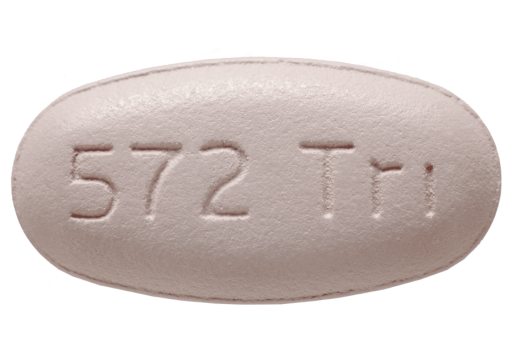 ABC 600 mg, DTG 50 mg, 3TC 300 mgImage
1 tablet daily Film-Coated Tablets Dolutegravir / Lamivudine (Dovato)
 DTG 50 mg, 3TC 300 mgImage
1 tablet daily Film-Coated Tablets Dolutegravir / Rilpivirine (Juluca)
 DTG 50 mg, RPV 25 mgImage
1 tablet daily
Clinical Use
Initial vs Subsequent Therapy
Current adult and adolescent treatment guidelines of the U.S. Department of Health and Human Services state that dolutegravir plus abacavir/lamivudine, tenofovir alafenamide/emtricitabine, or tenofovir DF/emtricitabine are "recommended initial regimens for most people with HIV."
In initial therapy, Phase III randomized double-blind studies (described above in "Approval") have compared dolutegravir with raltegravir and with efavirenz. In one study, patients were randomized to receive either dolutegravir (once daily) or raltegravir (twice daily), each given in combination with investigator-selected coformulated nucleoside analogues, either tenofovir/emtricitabine (60%) or abacavir/lamivudine. At 48 weeks, by snapshot analysis, 88% of the dolutegravir group and 85% of the raltegravir group achieved HIV RNA suppression to <50 copies/mL; this difference was not statistically significant. In subjects with HIV RNA >100,000 copies/mL at baseline, HIV RNA suppression rates were 82% and 75%, respectively. The median CD4 increase was 230 cells/µL in each group.(1)
In a second Phase III study of initial therapy, patients were randomized to receive either dolutegravir (once daily) + coformulated abacavir/lamivudine or the single-pill combination of efavirenz + tenofovir + emtricitabine. At 48 weeks, by snapshot analysis, HIV RNA was <50 copies/mL in 88% of dolutegravir recipients and 81% efavirenz recipients, a statistically significant result (p = .003). In subjects with HIV RNA >100,000 copies/mL at baseline, HIV RNA suppression rates were 83% and 76%, respectively. Virologic failure occurred in 4% of each treatment group; a lower proportion of subjects discontinued treatment owing to adverse effects in the dolutegravir group (2%) than in the efavirenz group (10%). CD4 increases were 267 cells/µL in dolutegravir recipients and 208 cells/µL in the efavirenz group.(2)
Also in previously untreated individuals, a randomized open-label study compared dolutegravir and ritonavir-boosted darunavir, each given with investigator-selected NRTIs (either tenofovir/emtricitabine [75%] or abacavir/lamivudine [25%]); all given once daily. At 48 weeks, by snapshot analysis, HIV RNA was <40 copies/mL in 90% of the dolutegravir group and 83% of the darunavir/ritonavir group (p = .025). Median CD4 cell increases were the same in each group (210 cells/µL). In patients with HIV RNA levels of >100,000 copies/mL at baseline, more patients in the dolutegravir group achieved virologic suppression (93% vs 70%). Fewer patients in the dolutegravir group withdrew from the study because of adverse effects.(3)
In treatment-experienced patients with resistance to at least 2 classes of antiretrovirals but no previous exposure to integrase inhibitors, a randomized controlled Phase III study compared dolutegravir (50 mg once daily) with raltegravir, each in combination with other antiretrovirals as selected by investigators (background regimens were required to include at least 1 agent with full activity against HIV). At 48 weeks, 71% of patients in the dolutegravir group and 64% of patients in the raltegravir group had HIV RNA levels of <50 copies/mL (p = .03). Mean CD4 count increases were 162 cells/µL and 153 cells/µL, respectively.(4)
In treatment-experienced patients with resistance to integrase inhibitors raltegravir or elvitegravir as well as to at least 2 other classes of antiretrovirals, a single-arm study found that use of dolutegravir (50 mg twice daily) plus an optimized background antiretroviral regimen resulted in HIV suppression to <50 copies/mL in 69% of patients at week 24.(5) Response rates were correlated with the specific integrase inhibitor mutations present at baseline (see "Resistance," below).
The combination of dolutegravir + rilpivirine has been studied in two parallel randomized open-label Phase III switch studies in patients on a stable 3-drug antiretroviral regimen. Subjects had to have had HIV RNA levels of <50 copies/mL for at least 12 months, no history of virologic failure, and no resistance to antiretroviral medications. They were randomized to switch to dolutegravir + rilpivirine or to continue their 3-drug regimen. After 48 weeks, 97% of both groups maintained HIV virologic suppression to <50 copies/mL, indicating noninferiority of the dolutegravir + rilpivirine regimen.(6) This combination has been approved by the FDA as a replacement regimen for persons who have been on a stable antiretroviral regimen for ≥6 months, have had HIV RNA suppression to <50 copies/mL for >12 months, no history of treatment failure, and no known drug mutations associated with resistance to dolutegravir or rilpivirine.(7)
Adverse Effects
In clinical studies, symptomatic adverse effects of dolutegravir were uncommon but included headache, insomnia, mood disturbance and, rarely, rash. Hypersensitivity reaction, including rash and systemic symptoms, has been reported; if hypersensitivity reaction is suspected, dolutegravir should be discontinued immediately. Laboratory abnormalities include increases in hepatic transaminase levels; the risk of liver abnormalities appears to be higher in patients with hepatitis B or hepatitis C.(1),(2),(8) Dolutegravir increases serum creatinine by inhibiting tubular secretion of creatinine but has no effect on actual glomerular filtration rate.(7) In Phase III studies of initial therapy, mean serum creatinine elevations were approximately 0.11-0.14 mg/dL; these were seen in the first 4 weeks of treatment and remained stable to 48 weeks.(1),(2),(9)
It is important to assess patient motivation and discuss possible adverse effects and strategies for their management before treatment with dolutegravir is initiated.
In one study in Botswana, an elevated rate of neural tube defects was seen in infants born to women who were taking dolutegravir at the time of conception and in the early weeks of pregnancy. No increased rate of birth defects was seen in this study or others among women who started dolutegravir later in pregnancy.(10),(11) Pending availability of more data on the safety of dolutegravir during pregnancy, use of dolutegravir is not recommended for women who are trying to conceive or are in the first trimester of pregnancy.(12)
Interactions with Other Drugs
Dolutegravir interacts with several medications, including other antiretroviral agents. Dolutegravir is metabolized primarily by glucuronidation, particularly by uridine diphosphate glucuronosyltransferase (UGT) 1A1, and to a lesser degree by hepatic isoenzyme CYP3A. Inducers or inhibitors of these enzymes may affect serum levels of dolutegravir.
For example, the nonnucleoside reverse transcriptase inhibitors efavirenz and etravirine and the protease inhibitor combinations fosamprenavir/ritonavir and tipranavir/ritonavir may cause significant decreases in serum dolutegravir levels. In some cases, dosage adjustments or alternative therapies may be required (see "Dosing of Dolutegravir," above). In the case of etravirine, coadministration with darunavir/ritonavir or lopinavir/ritonavir appears to largely offset the substantial decrease in dolutegravir concentrations caused by etravirine. Rifampin and other strong UGT 1A1 inducers, such as carbamazepine and phenytoin, also may decrease dolutegravir levels. Coadministration with rifampin requires dosage adjustment of dolutegravir; coadministration with other strong metabolic inducers is not recommended until further data on interactions with dolutegravir are available.(8) It is particularly important to avoid inducers of dolutegravir metabolism in patients whose HIV virus is known or suspected to be resistant to dolutegravir and in whom high plasma levels of dolutegravir may be required for therapeutic effect.
Dolutegravir does not affect cytochrome P450 enzyme systems but inhibits the organic cation transporter 2 (OCT2) and may increase plasma levels of OCT2 substrates including metformin and dofetilide. Dosage adjustment of metformin may be required and concurrent administration of dofetilide is contraindicated.
Gastrointestinal absorption of dolutegravir is greatly impaired by concurrent administration with polyvalent cations (eg, aluminum, calcium, iron, and magnesium cations), including those contained in some antacids, laxatives, buffered medications, and mineral supplements. Polyvalent cations should be taken =2 hours before or =6 hours after dolutegravir, though calcium or iron supplements may be taken with dolutegravir if they are also taken with food. Proton pump inhibitors and H2 receptor antagonists do not affect dolutegravir concentrations.(8)
Information on drug interactions should be consulted, as dosage adjustments are frequently required and some combinations are contraindicated.
Resistance
Resistance to dolutegravir is associated with the selection of 1 or more of several resistance mutations; however, the resistance profile of dolutegravir in human subjects has not been characterized fully. In vitro studies of dolutegravir show the emergence of a number of integrase mutations, but in clinical studies, there has been little evidence to date of the development of new, therapeutically significant resistance to dolutegravir. In the Phase III studies of dolutegravir in antiretroviral-naive patients, no resistance to either dolutegravir or the coadministered nucleoside analogues emerged in persons who experienced virologic failure. On the other hand, resistance associated with previous exposure to other integrase inhibitors may affect the efficacy of dolutegravir, particularly with substitution at integrase amino acid 148 plus 2 or more additional resistance substitutions, including L74I/M, E138A/D/K/T, G140A/S, Y143H/R, E157Q, G163E/K/Q/R/S, and G193E/R.(5),(13)
Implications of dolutegravir resistance for treatment with other antiretrovirals
The degree to which resistance mutations selected by dolutegravir confer resistance to other integrase inhibitors is not known. In clinical trials of dolutegravir in patients with no previous exposure to integrase inhibitors, the few emergent integrase resistance mutations that have been reported include L74I/M, Q95Q/L, V151V/I, E157Q/P, and R263K. These mutations have not been associated with phenotypic decreases in susceptibility to dolutegravir or to raltegravir.(1),(2),(4),(8),(14)
Dolutegravir mutations are not expected to affect sensitivity to other classes of antiretroviral agents.
Implications of resistance to other antiretrovirals for dolutegravir treatment
Resistance mutations selected by the integrase inhibitors raltegravir and elvitegravir may contribute to dolutegravir resistance. Both the specific integrase mutations and the number of mutations affect viral susceptibility to dolutegravir. The likelihood of virologic response to dolutegravir is greatly reduced if the virus has a Q148H/R mutation plus 2 or more other integrase inhibitor mutations (eg, L74I/M, E138A/D/K/T, G140A/S, Y143H/R, E157Q, G163E/K/Q/R/S, and G193E/R).(5),(13),(14)
Phenotypic analysis has shown that virologic response to dolutegravir decreases sharply with increases in the dolutegravir fold change in the IC50 (half maximal inhibitory concentration).(5)
Resistance mutations selected by other classes of antiretrovirals are not expected to contribute to dolutegravir resistance.
Resources and Links
References
- 1Raffi F, Rachlis A, Stellbrink HJ, et al; SPRING-2 Study Group. Once-daily dolutegravir versus raltegravir in antiretroviral-naive adults with HIV-1 infection: 48 week results from the randomised, double-blind, non-inferiority SPRING-2 study. Lancet. 2013 Mar 2;381(9868):735-43.
- 2Walmsley SL, Antela A, Clumeck N, et al; SINGLE Investigators. Dolutegravir plus abacavir-lamivudine for the treatment of HIV-1 infection. N Engl J Med. 2013 Nov 7;369(19):1807-18.
- 3Clotet B, Feinberg J, van Lunzen J, et al; ING114915 Study Team. Once-daily dolutegravir versus darunavir plus ritonavir in antiretroviral-naive adults with HIV-1 infection (FLAMINGO): 48 week results from the randomised open-label phase 3b study. Lancet. 2014 Jun 28;383(9936):2222-31.
- 4Cahn P, Pozniak AL, Mingrone H, et al; SAILING Study Team. Dolutegravir versus raltegravir in antiretroviral-experienced, integrase-inhibitor-naive adults with HIV: week 48 results from the randomised, double-blind, non-inferiority SAILING study. Lancet. 2013 Aug 24;382(9893):700-8.
- 5Castagna A, Maggiolo F, Penco G, et al; VIKING-3 Study Group. Dolutegravir in antiretroviral-experienced patients with raltegravir- and/or elvitegravir-resistant HIV-1: 24-week results of the phase III VIKING-3 study. J Infect Dis. 2014 Aug 1;210(3):354-62.
- 6Llibre JM, Hung CC, Brinson C, et al. Phase III SWORD 1&2: switch to DTG+RPV maintains virologic suppression through 48 wks. In: Program and abstracts of the 2017 Conference on Retroviruses and Opportunistic Infections; February 13-16, 2017; Seattle. Abstract 44LB.
- 7Juluca prescribing information. ViiV Healthcare: Research Triangle Park, NC.
- 8Tivicay prescribing information. ViiV Healthcare: Research Triangle Park, NC.
- 9Curtis LD, Min S, Nichols G, et al; SPRING-2 and SINGLE Teams. Once-daily dolutegravir (DTG; S/GSK1349572) has a renal safety profile comparable to raltegravir (RAL) and efavirenz in antiretroviral (ART) naive adults: 48 week results from SPRING-2 (ING113086) and SINGLE (ING114467). In: Program and abstracts of the 7th International Antiviral Society Conference on HIV Pathogenesis, Treatment and Prevention; June 30-July 3, 2013; Kuala Lumpur. Abstract TUPE282.
- 10 Zash R, Makhema J, Shapiro RL. Neural-tube defects with dolutegravir treatment from the time of conception. N Engl J Med. 2018 Sep 6;379(10):979-981.
- 11Zash R, Holmes L, Makhema J, et al. Surveillance for neural tube defects following antiretroviral exposure from conception. Presented at the 22nd International AIDS Conference; July 23-27, 2018; Amsterdam.
- 12HHS Panel on Treatment of Pregnant Women with HIV Infection. Update to the Recommendations for the Use of Antiretroviral Drugs in Pregnant Women with HIV Infection and Interventions to Reduce Perinatal HIV Transmission in the United States. December 7, 2018. Available at https://aidsinfo.nih.gov/guidelines.
- 13Underwood MR, Johns BA, Sato A, et al. The activity of the integrase inhibitor dolutegravir against HIV-1 variants isolated from raltegravir-treated adults. J Acquir Immune Defic Syndr. 2012 Nov 1;61(3):297-301.
- 14Wainberg MA, Mesplède T, Quashie PK. The development of novel HIV integrase inhibitors and the problem of drug resistance. Curr Opin Virol. 2012 Oct;2(5):656-62.
-